 MacMotion
What is the 20-20-20 rule?
The American Optometric Association recommends a simple habit to ease digital eye strain: every 20 minutes, take a 20-second break to look at something 20 feet away 1. Twenty feet is about six metres: the other side of a room, or better, something out of a window.
Why screens tire your eyes
Two things happen when you look at a screen for hours:
- You blink less. People normally blink about 15 times a minute, but only about 5 to 7 times a minute while using screens, according to the American Academy of Ophthalmology 2. Blinking keeps the surface of your eyes moist, so fewer blinks means drier, more irritated eyes.
- Your focus is locked. Your eyes hold the same close focus for long stretches. Looking into the distance gives the focusing muscles a chance to relax and refocus 1.
The AOA groups the resulting symptoms, like eye strain, dry eyes and blurred vision, under the name “computer vision syndrome” or digital eye strain, and notes that it appears to increase with the amount of screen use 1.
How to do it properly
- Look genuinely far away. Across the room is good; out of a window is better. A spot on your wall a metre away doesn’t count.
- Give it the full 20 seconds. Count slowly or take three slow breaths.
- Blink on purpose. A few full, slow blinks help re-wet your eyes 1.
- Take a longer break too. The AOA also suggests resting your eyes for 15 minutes after two hours of continuous computer use 1, a good moment to stand up and move.
Set up your screen to help
OSHA’s workstation guidance recommends putting your monitor directly in front of you, at least 20 inches (about 50 cm) away, with the top line of the screen at or below eye level. Place it at a right angle to windows to reduce glare 3. A screen that’s too close or too high makes your eyes and neck work harder.
Why it’s hard to remember (and how to fix that)
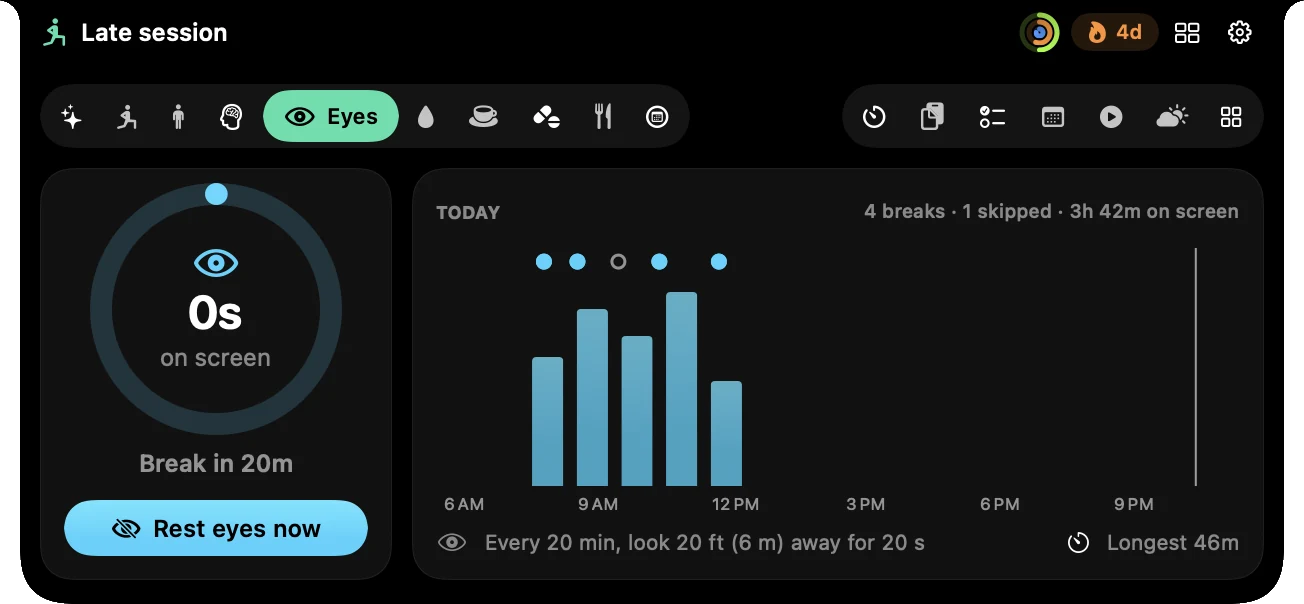
The rule is easy. Remembering it every 20 minutes during focused work is not. Nobody looks up from a hard problem and thinks “it’s been 20 minutes”. That’s why a reminder works better than willpower: something that appears where you’re already looking, and goes away once you’ve rested.
FAQ
Does the 20-20-20 rule really work?
It’s a simple, widely recommended habit from optometrists for easing digital eye strain 1. It works by giving your focusing muscles a rest and reminding you to blink. If symptoms continue, see an eye doctor.
Does it have to be exactly 20 feet?
No. The point is to look far enough away that your eyes fully relax their focus. Anything across the room or out of a window works.
Is the 20-20-20 rule enough on its own?
It helps most when combined with a good screen setup, frequent blinking and longer breaks: the AOA suggests 15 minutes of rest after two hours of continuous computer use 1. Regular eye exams matter too.
Can screens permanently damage my eyes?
The American Academy of Ophthalmology’s guidance focuses on the discomfort of eye strain and how to relieve it 2. If you have ongoing symptoms like blurred vision or headaches, get your eyes checked.
Sources
- American Optometric Association. Computer vision syndrome. www.aoa.org/healthy-eyes/eye-and-vision-conditions/computer-vision-syndrome
- American Academy of Ophthalmology. Computers, digital devices and eye strain. www.aao.org/eye-health/tips-prevention/computer-usage
- OSHA. Computer workstations eTool: monitors. www.osha.gov/etools/computer-workstations/components/monitors
This guide is general information, not medical advice. If something hurts, or you have a heart, joint or other health condition, check with a doctor or physiotherapist before starting new exercise.