 MacMotion
How much caffeine is too much?
The European Food Safety Authority considers intakes of up to 400 mg a day, spread through the day, safe for healthy adults in the general population, with pregnant women the exception 1. The U.S. Food and Drug Administration uses the same 400 mg figure, and notes that caffeine content varies widely between drinks 2.
Sleep is more sensitive than safety limits. EFSA notes that single doses of 100 mg may affect how long and how well some adults sleep, particularly when taken close to bedtime 1.
How long does caffeine last?
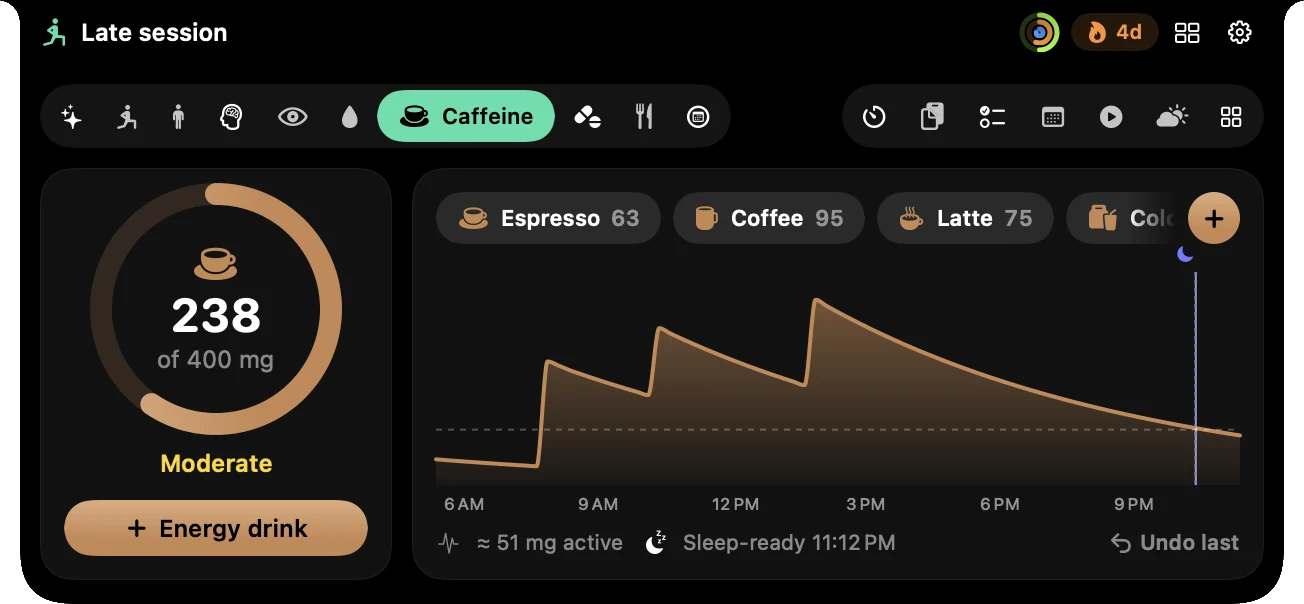
Caffeine leaves your body gradually rather than all at once. A half-life of about 5 hours is a commonly used average (it’s what MacMotion uses to estimate how much is still active), but it varies a lot from person to person. In practice that means an afternoon coffee can still be partly active at bedtime.
What the research says about timing
In a 2013 study, adults took 400 mg of caffeine at bedtime, 3 hours before bed or 6 hours before bed, and a placebo on other nights. All three caffeine doses significantly disrupted sleep compared with placebo, including the dose taken 6 hours before bed. The researchers concluded that the results support avoiding substantial caffeine for at least 6 hours before bedtime 3.
A simple rule for your last cup
- Take your usual bedtime and subtract at least 6 hours. Bed at 11 PM means your last substantial caffeine by 5 PM 3. If you’re sensitive, make it earlier.
- Count all sources. Coffee, tea, energy drinks, cola and some pre-workout products all add up.
- Swap the 3 PM coffee for movement. A short burst of activity can wake you up without touching your sleep. Try a two-minute exercise snack.
- Drink water too. Afternoon tiredness is sometimes just a long gap since your last drink. See how much water to drink at work.
FAQ
What time should I stop drinking coffee?
At least 6 hours before bed. In a controlled study, caffeine taken 6 hours before bedtime still disrupted sleep 3. If you’re sensitive to caffeine, stop earlier.
How much caffeine is safe per day?
Up to 400 mg a day is considered safe for most healthy adults, except during pregnancy 1.
How much caffeine is in a cup of coffee?
It varies a lot by drink, size and brewing method 2. Check labels where you can, and log what you actually drink.
Sources
- European Food Safety Authority. Caffeine. www.efsa.europa.eu/en/topics/topic/caffeine
- U.S. Food and Drug Administration. Spilling the beans: how much caffeine is too much? www.fda.gov/consumers/consumer-updates/spilling-beans-how-much-caffeine-too-much
- Drake C, et al. (2013). Caffeine effects on sleep taken 0, 3, or 6 hours before going to bed. Journal of Clinical Sleep Medicine. doi.org/10.5664/jcsm.3170
This guide is general information, not medical advice. If something hurts, or you have a heart, joint or other health condition, check with a doctor or physiotherapist before starting new exercise.